
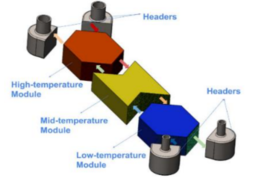
Bi-metal Heat Exchanger design using coupled PBF and DED AM processes
Energy, Environment, & Aerospace
Abstract
The Bi-Metal Heat Exchanger Design is a heat exchanger that focuses on monetary cost optimization and can be implemented with concentrated solar power applications.
Problem
Concentrated solar power (CSP) is important in solving the global energy crisis. However, materials for the superalloys CSP heat exchangers rely on are in short supply, creating large costs, and future supply problems.
Solution
The bi-metal heat exchanger design was created to significantly reduce the cost of CSP heat exchangers, while still maintaining the structural strength needed to withstand the heat and other pressures of ongoing use in CSP.
Value Proposition
Reduces the cost of materials and manufacturing for heat exchangers that use nickel-based superalloys.
Benefit
Renewable energy sources, like concentrated solar power (CSP), are important aspects in solving the global energy crisis. However, the globe is also facing a shortage of nickel, currently used in the superalloys that CSP heat exchangers rely on. This imbalance creates large costs and future supply problems.
The bi-metal heat exchanger design was created to significantly reduce the cost of CSP heat exchangers, while still maintaining the structural strength needed to withstand the heat and other pressures of ongoing use in CSP.
Market Application
This technology is meant for use in CSP heat exchangers and will be used by heat exchange manufacturers looking to license a technology that can reduce costs while maintaining structural quality.
I Have an Inquiry About This Technology
Inventors
USU Department: Mechanical & Aerospace Engineering
Funding
This invention was made with government support under DE-EE0009381 awarded by the U.S. Department of Energy. The government has certain rights in the invention.
USU Reference No. C22027