
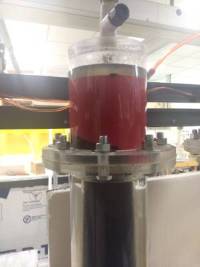
Gas-Liquid-Solid Separation Device for Up-flow Anaerobic Reactors
Energy, Environment, & Aerospace
Problem
UASB reactors use anaerobic digestion to treat wastewater but can lose active biomass by washout, reducing performance. Large systems use bulkier inclined‑plate clarifiers to prevent this, but narrow lab‑scale reactors are unavailable.
Solution
A 3D‑printed, single‑piece helical lamella clarifier for cylindrical lab‑scale (UASB) reactors. It lengthens particle paths, enhancing gas/liquid/solid separation and biomass retention while reducing washout.
Value Proposition
Tunable helix pitch, height, diameters and baffle angles let one generic 3D‑printed model be customized for any small cylindrical UASB reactor. As a one‑piece, plug‑and‑play unit, it’s simple, low‑cost, and replaceable.
Benefit
The Up-flow Anaerobic Sludge Blanket (UASB) reactor is an efficient biological wastewater treatment system that utilizes anaerobic digestion to convert organic matter into biogas. UASB reactors can lose active biological solids from the sludge blanket via washout through the water outlet at the top of the tank. If biomass washout is significant, the sludge may take longer to adapt to the reactor and may not granulate properly, resulting in decreased power to treat the water. Large reactors commonly prevent this washout with inclined plate settlers (lamella clarifiers) installed downstream of the sludge blanket, but the narrow cylindrical shape of lab‑scale reactors makes those devices difficult to fit, and no commercial lamella clarifier is available for small reactors.
The present invention is a method of implementing inclined plane settlers (IPS) in cylindrical laboratory-scale UASB reactors using additive manufacturing techniques such as 3D printing. Instead of the traditional square settling plates, this lamella clarifier uses helical plates in which gas bubbles may then rise and separate from liquid and solid particles. Helical plates provide much greater path elongation than traditional flat plates in this application, resulting in more effective biomass retention. The clarifier may be 3D printed as a single piece and inserted directly into a lab-scale UASB reactor tank. Prototype testing has shown the design can significantly reduce biomass washout.
With tunable geometric parameters — including helix pitch, height, inner and outer diameters, and baffle angles — a single generic model can be customized to fit any small cylindrical UASB reactor. Fabricated as a one‑piece unit, the clarifier provides a compact, plug-and-play solution that is far simpler to install, remove, and maintain than bulkier inclined‑plate settlers. Moreover, 3D printing enables low-cost production and inexpensive replacement, making the device practical for use.
Market Application
This clarifier is designed primarily for small‑scale UASB reactors (1–25 L), offering a compact, plug‑and‑play separation solution for laboratory and bench‑scale wastewater treatment systems. While the underlying helical lamella concept can be scaled to larger reactors, doing so would increase cost and complexity; the product, therefore, targets research labs and teaching facilities, where improved solid and gas separation will enhance experimental outcomes and training. By reducing biomass washout and improving effluent quality in lab‑scale reactors, the clarifier helps students, researchers, and lab technicians achieve more reliable and reproducible results.
I Have an Inquiry About This Technology
Inventors
USU Department: College of Engineering, Biological Engineering Department
USU Reference No. C20056
U.S. Patent No. 12,441,642 issued December 15, 2022