
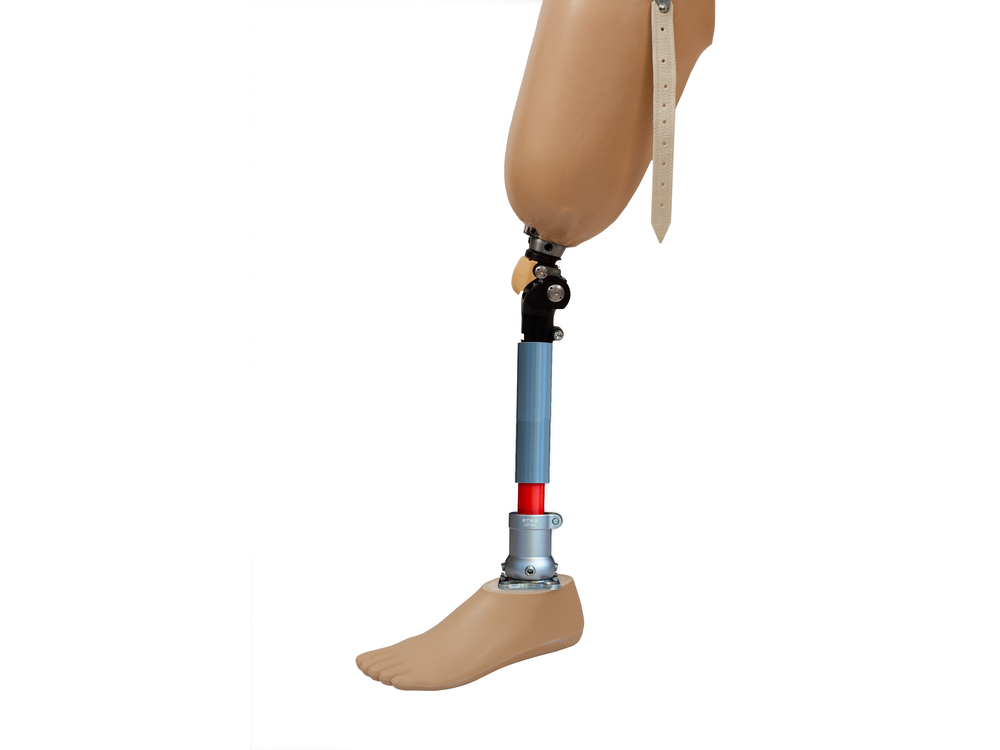
Conventional prosthetic legs have fixed lengths, which limits stability on uneven terrain and creates discomfort in seated positions. The Prosthetic Leg Length Adjustment System introduces an actuated telescoping mechanism that allows users to extend or s...

In construction of large buildings, impulse response and resonance frequency are considered so that building designs can be resilient to local seismological threats. This technology provides a method by which to estimate the impulse response of a geograph...

USU researcher Scott Greenhalgh has developed a novel fall protection device for use in rock climbing that uses frictional force to ensure safety on rock faces with minimal surface area where other protections devices could be used.

Traditional and hands-free crutches limit mobility, comfort, and weight-bearing transition due to restricted knee movement. This USU device shifts weight to the thigh, allowing knee bend and adjustable leg loading, enhancing comfort while sitting, enablin...

The Bulkhead Liner is made of a two-step plastic molding process that introduces patterned ribs inside of a liner for composite pressure vehicles to hold and transport hydrogen gasses, while maintaining structure and preventing leakage.

Traditional SWIR materials are composed of toxic materials such as InGaAs, HgCdTe, InSb, and recent Pb-based pervoskites. These materials are toxic and unstable. This technology is for an environmentally-friendlier "Pb-free" double perovskite short-wave I...

This technology provides a non-thermally conductive concrete lifting anchor to improve efficiency in crane lifting concrete panels in large building construction.
USU's climbing gear removal tool is a technology designed to allow rock climbers to remove nut pieces from rock in a less painful and more efficient way.

The Crescent Cam is a new take on camming devices for climbers. It gracefully combines the actions of releasing the cam from the climber's harness and placing the cam into a rock wall.