
Request an Unwanted Materials Pickup
All fuel containers, gas cylinders, aerosol cans, or similar, should be disposed of through the approved pickup process even if "empty."
Log In & Register
Log in to the EHS Assistant (EHSA) using your University A# and strong password.
First-time Users
You will be prompted to "Create a Waste Profile." Image icon Fill out all of the requested information Image icon and save your profile.
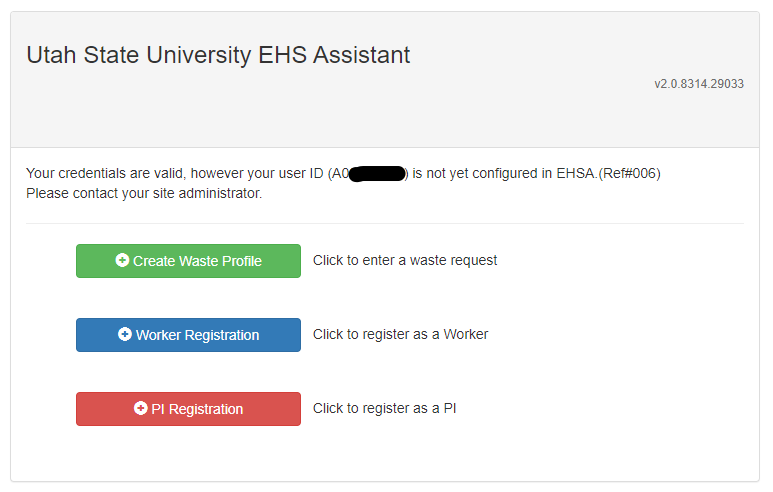
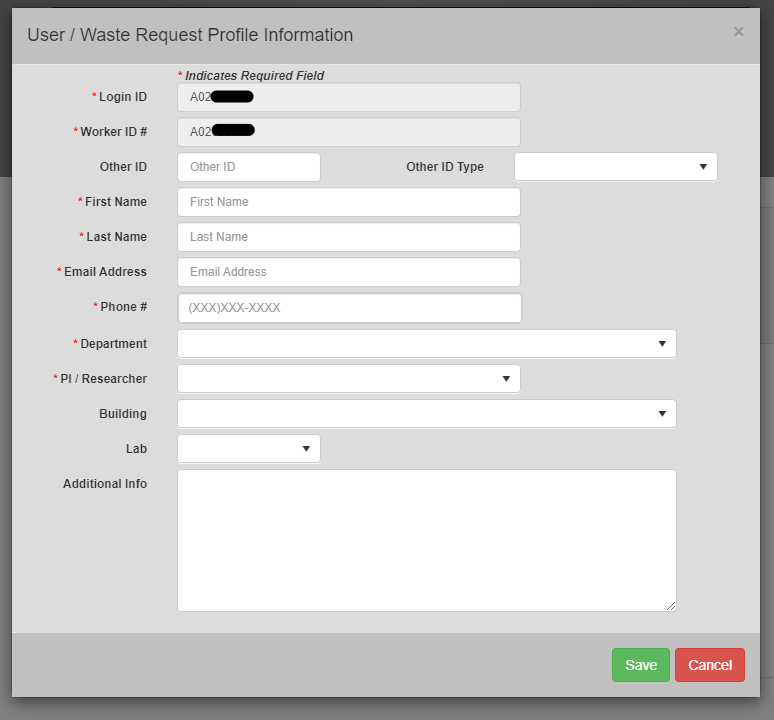
You may edit profile details later, including building and room number, in your Waste Profile. You are given access to this each time you initiate a pickup request.
Create a Pickup Request
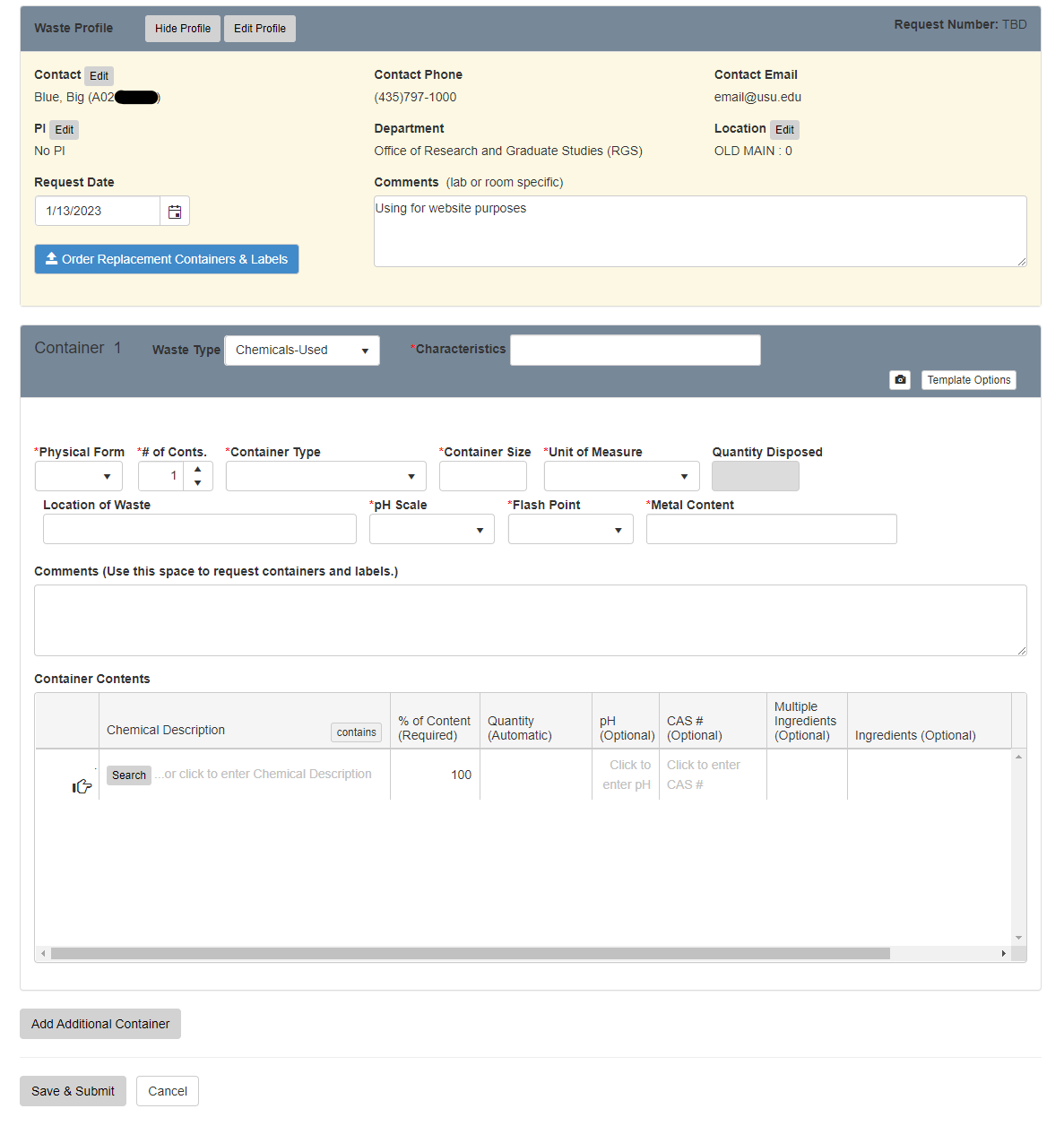
Select the "Hazardous Waste" icon to begin. You will see your Waste Profile and fields to enter container information.
Provide as much information as you can for each container you need picked up. Be specific about the location of each.
Multiple Materials
You must fill out one container entry per material. Select the option to "Add Additional Container" if this is the case.
Multiple Containers of the Same Material
Fill out one container entry and specify the total number of containers in the "# of Conts." field.
Chemical Description
Manually type a description of the material as it appears on the container label (preferred) or use the search-as-you-type function.
If the container has no label, mark it as "unknown".
Save & Submit
Once all the information for your containers is completed, select the "Save & Submit" button at the bottom of the page. This will notify unwanted materials pick-up personnel who will come and gather the waste material.
Before a container is picked up, you MUST print the Unwanted Materials Label and attach it to the Unwanted Materials container. The EHS office is unable to pick up items without the proper label attached to them.
Label Your Material
Print Labels
Once you submit your request, you will be directed to a page where you can print your "Unwanted Materials" labels. Click the green "Print Unwanted Materials Label" box Image icon to generate them. You will then be taken to the label page Image icon , where you can print the label(s).


Attach Labels
You must cut the labels to size and tape them securely to the corresponding containers.
Note: The EHS office cannot pick up any items that do not have the proper "Unwanted Materials" label attached.
Small Containers
If you have multiple small containers of the same material, you may place them in a single disposable outer box and attach one label to that box.
Await Pickup
You should receive a confirmation email shortly after submitting your request. If you do not receive this email, your request may not have been processed correctly.
Please take a few minutes and read through the new Lab Procedures Manual.
Need Help?
If you have questions or require special labels for materials that accumulate over several days, please contact:
Dale Elwood
dalef.elwood@usu.edu
(435) 797-1053
Definitions from OSHA 29 CFR 1910.1200
Hazardous chemical means any chemical which is classified as a physical hazard or a health hazard, a simple asphyxiant, combustible dust, or hazard not otherwise classified.
Hazard class means the nature of the physical or health hazards, e.g., flammable solid, carcinogen, oral acute toxicity.
Hazard not otherwise classified (HNOC) means an adverse physical or health effect identified through evaluation of scientific evidence during the classification process that does not meet the specified criteria for the physical and health hazard classes addressed in this section. This does not extend coverage to adverse physical and health effects for which there is a hazard class addressed in this section, but the effect either falls below the cut-off value/concentration limit of the hazard class or is under a GHS hazard category that has not been adopted by OSHA (e.g., acute toxicity Category 5).
Gas means a substance which (i) At 122 °F (50 °C) has a vapor pressure greater than 43.51 PSI (300 kPa) (absolute); or (ii) Is completely gaseous at 68 °F (20 °C) at a standard pressure of 14.69 PSI (101.3 kPa).
Health hazard means a chemical which is classified as posing one of the following hazardous effects: acute toxicity (any route of exposure); skin corrosion or irritation; serious eye damage or eye irritation; respiratory or skin sensitization; germ cell mutagenicity; carcinogenicity; reproductive toxicity; specific target organ toxicity (single or repeated exposure); or aspiration hazard. The criteria for determining whether a chemical is classified as a health hazard are detailed in Appendix A to § 1910.1200—Health Hazard Criteria.